

The short answer
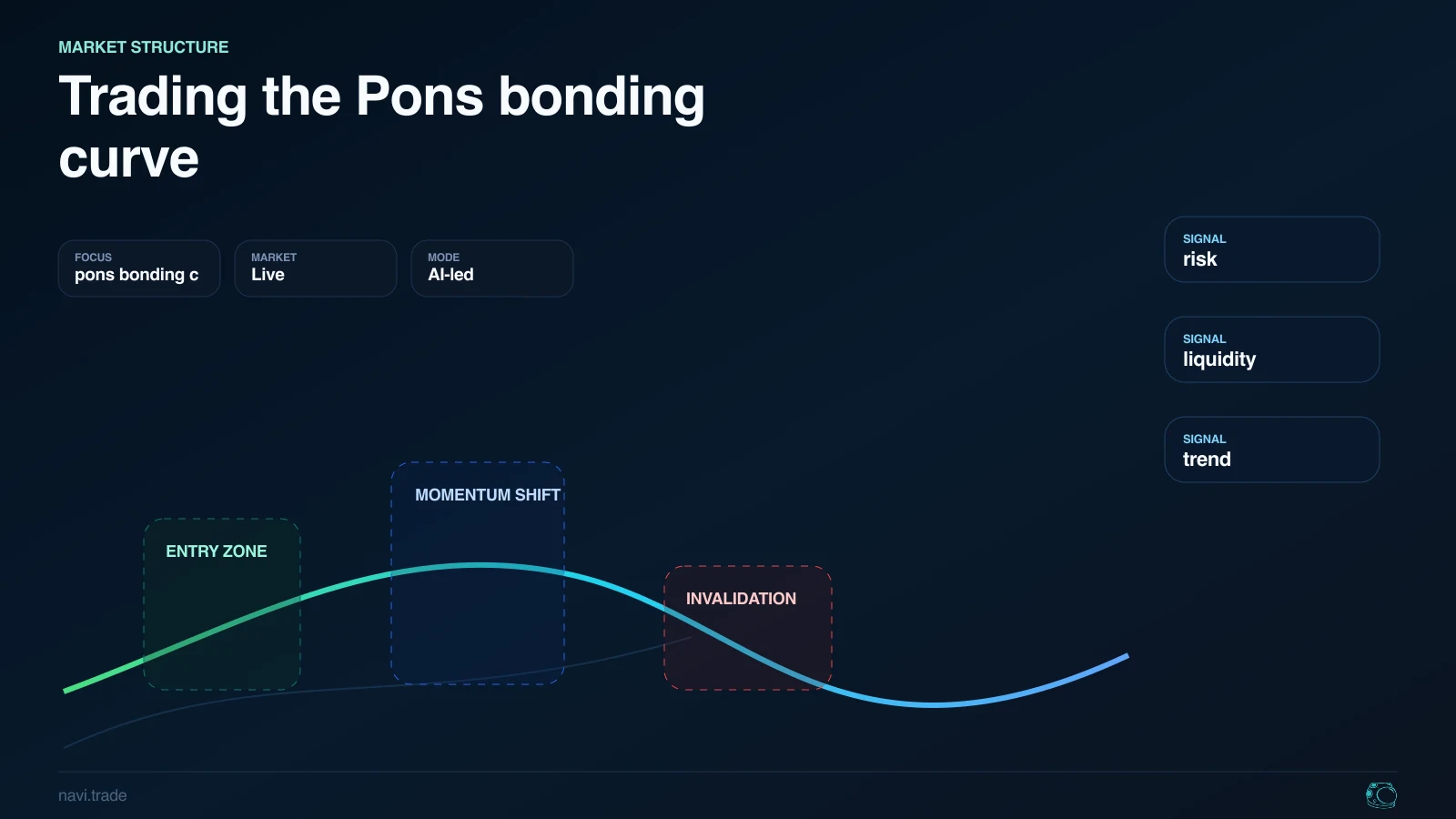
The Pons bonding curve is the pricing contract every new Pons token trades against at launch. Buys push the price up, sells push it down, and once an ETH-quoted curve has taken in 4.2 ETH the token graduates into a Uniswap v4 pool with locked liquidity. On NAVI, a token still on its curve shows a Pons · Bonding badge with its curve progress, and swaps against it are labelled Bonding.
Pons is an independent memecoin launchpad on Robinhood Chain. It is not made by Robinhood, and NAVI is not affiliated with Robinhood or Pons.
How the Pons bonding curve works
NAVI read these figures from the Pons V2 factory on 30 September 2026:
- Supply: each launch mints 1 billion tokens.
- Launch fee: 0.0005 ETH.
- Curve fee: 1% per trade.
- Creator tax: optional, up to 10%.
- Starting reserve: the curve starts with a virtual ("phantom") reserve of 1.68 ETH, which sets the opening price without real ETH behind it.
- Graduation: 4.2 ETH for ETH-quoted launches. Curves quoted in other assets use their own per-asset threshold.
On the fee split, Datawallet's summary of Pons's docs describes the 1% as 70% to the creator and 30% to the protocol. Confirm the current split in the Pons app, as we could not read Pons's own docs from the UK.
Pons V2 shipped around late July 2026, according to crypto.news, bringing ETH-denominated curves, Uniswap v4 hooks, extra quote assets and the optional creator tax. Our Pons launchpad explainer covers the background.
Finding a Pons token and reading its curve progress
Browse new Pons launches still on their curve, the Pons launchpad page or NAVI's Robinhood Chain hub, or paste a contract address into the Robinhood Chain token scanner. A token still on its curve carries the Pons · Bonding badge with curve progress toward 4.2 ETH. A graduated token shows the pool it moved into instead.
What the progress number tells you:
- Low progress: little ETH has gone in, so each buy moves the price more and the token has barely been tested by the market.
- High progress: the token is close to graduating. Many buyers may be competing for the last part of the curve.
- Progress falling: sellers are taking ETH back out of the curve.
Pons chart options. Beyond NAVI's token page, GeckoTerminal indexes pre-graduation Pons curves as pools (dex "pons-v2") and graduated pools separately ("pons-v2-dex"). NAVI's check of DexScreener's API found that graduated Pons pools appear there as plain Uniswap v4 pairs with no Pons label, and it did not return a token's pre-graduation curve. Reported liquidity for the same pool also differed between the two screeners, so treat any single number with care.
How to buy on Pons through NAVI
- Step 1: hold ETH on Robinhood Chain in a wallet NAVI supports (Phantom, Rabby, MetaMask, Coinbase Wallet or a WalletConnect mobile wallet). From Solana, use the Cross-chain tab to bridge Solana to Robinhood Chain.
- Step 2: open the token page and read the risk result: Low, Medium or High, never "safe".
- Step 3: in the swap panel, enter an ETH amount. Before graduation, the route is labelled Bonding, meaning the trade goes straight against the Pons curve.
- Step 4: check the quote. It includes NAVI's 0.25% swap fee (lower on Pro), shown before you sign. The Pons 1% curve fee and any creator tax come on top; NAVI's buy-and-sell simulation measures the tax you would actually pay.
- Step 5: sign with your wallet. NAVI is non-custodial.
Selling works the same way in reverse while the token is on its curve. Gas is small: NAVI measured a median swap on 30 September 2026 at about 0.0000039 ETH, roughly one US cent. For the wider buying flow, see how to buy memecoins on Robinhood Chain.
What changes after graduation, and slippage near 4.2 ETH
At graduation the curve's liquidity moves into a Uniswap v4 pool that uses the Pons hook. The LP position is held by the Pons launch locker, so it is locked rather than held by the creator. After graduation the hook takes the trading fee; press reports say the 1% continues. On NAVI, the Bonding label drops away and swaps route through KyberSwap instead, and the token page shows the graduated pool and its lock.
Slippage near graduation. The last stretch of the curve is where buyers crowd in. Price can move a long way between your quote and your confirmation. Set slippage too tight and the trade fails; set it too loose and you can pay far more than quoted. A token that graduates is not a success signal by itself. NAVI counted 51,046 Pons V2 launches and 567 graduations from 23 to 30 September 2026, about 1.1%, and graduation says nothing about what the price does next. Our Pons graduation rate post has the full numbers.
Why Stock-Token-quoted curves are unavailable on NAVI
Pons curves can be quoted in assets other than ETH. In NAVI's count for 23 to 30 September 2026, 78% of launches (39,788) were ETH-quoted, about 8% (3,856) used USDG, about 5% (2,615) used the NVDA Stock Token, and the rest used other Stock Tokens and assets.
Stock Tokens are ERC-20 tokens issued by Robinhood Assets (Jersey) Limited that give economic exposure to US shares and ETFs, per Robinhood's Stock Token docs. They are not available to US persons and are restricted in several countries, including the United Kingdom, Canada and Switzerland. On NAVI, Stock Tokens are information only. NAVI never trades them and never routes a swap through one, so Pons curves priced in a Stock Token cannot be traded on NAVI. You can still look up the token page for information. NAVI also flags look-alike tokens that copy a Stock Token name. Read more in Stock Tokens vs memecoins.
Red flags on a Pons curve
Very fast graduation. Of 540 tokens that launched and graduated inside NAVI's 7-day window, the median time to graduate was about 11 minutes and a quarter graduated within about 40 seconds of launch. A curve that fills in seconds can mean a few wallets bought most of the supply at the opening price.
Anti-bot exemption lists. Pons V2 applies a 99% anti-bot tax at launch, but creators can exempt a list of wallets. Analyst Wazz traced one group that took at least $18.43M across 53 launches, with 15 to 25 exempt wallets per launch and single purchases emptying the curve for 82 to 86% of supply, according to CryptoTimes. Open-source bundler tools openly advertise this exemption.
Concentrated holders. NAVI's holder check shows top-10 and largest-wallet share, excluding pools, burns, lockers and the Pons curve itself, so the numbers reflect real wallets.
High creator tax or a blocked sell. The simulation measures both. A tax of 25% or more, or a sell that cannot go through, forces a High rating.
Robinhood Chain bubble maps are not shipped on NAVI yet, so a bundle spread across many fresh wallets may not show up as concentration. Our rug ring breakdown explains the pattern.
Regions, and where to start on NAVI
Pons states that it does not operate in the United Kingdom or in OFAC-sanctioned jurisdictions. Trading on NAVI is not available in every region either. Never try to get around a regional block. If you use Pons directly, reach it only through links in its official channels and check the address bar. Phishing links were widely reported in the chain's first weeks.
To start, open the Robinhood Chain token scanner, paste a Pons token address and read the curve progress and risk result before you trade. On Solana, the equivalent is NAVI's pump.fun token analysis with bonding status and charts.
Also on NAVI: the honeypot checker for a standalone sell test and token analytics for charts, pools and holders.
For fresh Robinhood Chain data, see how many Pons launches survive and Robinhood Chain volume and fees.
Trading Solana as well? See how to spot Solana rug pulls and the memecoin risk checklist.
Not financial advice. Most launches go to zero. Only trade what you can afford to lose.